“[The older generation of writers who had established the rules for modern fiction under the assumption that their experience was “universal”] gained the ability to write stories where they could “show” and not “tell" … They had this ability not because they were masterful stylists of language or because they dripped with innate talent. The power to “show, not tell” stemmed from the writing for an audience that shared so many assumptions with them that the audience would feel that those settings and stories were “universal.” (It’s the same hubris that led the white Western establishment to assume its medicine, science, and values superior to all other cultures …) Look at the literary fiction techniques that are supposedly the hallmarks of good writing: nearly all of them rely not on what was said, but on what is left unsaid. Always come at things sideways; don’t be too direct, too pat, or too slick. Lead the reader in a direction but allow them to come to the conclusion. Ask the question but don’t state the answer too baldly. Leave things open to interpretation… but not too open, of course, or you have chaos. Make allusions and references to the works of the literary canon, the Bible, and familiar events of history to add a layer of evocation—but don’t make it too obvious or you’re copycatting. These are the do’s and don’ts of MFA programs everywhere. They rely on a shared pool of knowledge and cultural assumptions so that the words left unsaid are powerfully communicated. I am not saying this is not a worthwhile experience as reader or writer, but I am saying anointing it the pinnacle of “craft” leaves out any voice, genre, or experience that falls outside the status quo. The inverse is also true, then: writing about any experience that is “foreign” to that body of shared knowledge is too often deemed less worthy because to make it understandable to the mainstream takes a lot of explanation. Which we’ve been taught is bad writing!”
It is very important that the language in your novel reflects the time and place in which the story is set.
For example, my story is set in Italy. My characters would never “ride shotgun”, a term coined in US in the early 1900s referring to riding alongside the driver with a shotgun to gun bandits.
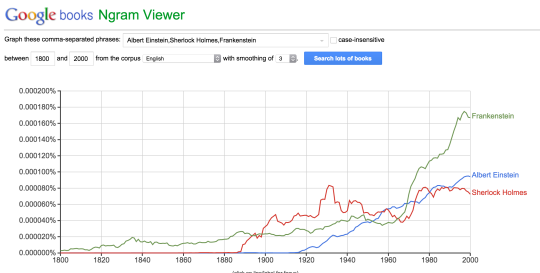
Do your research! A free tool that I found to be very useful is Ngram Viewer.
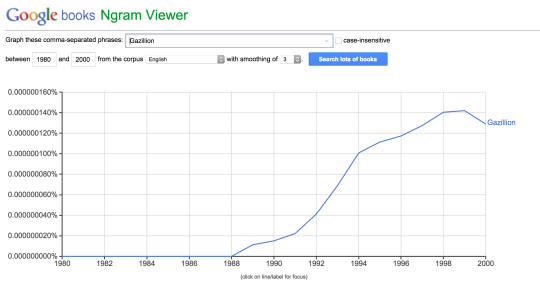
You can type any word and see when it started appearing in books. For example…one of my characters was going to say “gazillion” (I write YA) in 1994. Was “gazillion” used back then?
And the answer is…YES! It started trending in 1988 and was quite popular in 1994.
Enjoy ^_^
This is really important, especially because language can change in very unexpected ways.
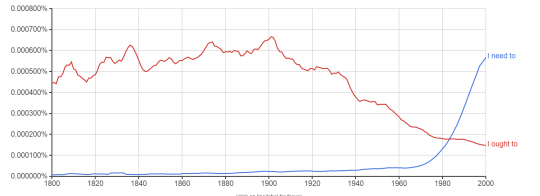
For example, did you know that before 1986 people never said “I need to”?Instead, they were far more likely to say “I ought to”, “I have to”, “I must”, or “I should”.
Don’t believe me?
Anyway, most people won’t notice subtle changes like that. But your reader will notice and be confused when characters in your medieval world use metaphors involving railroads and rockets.
One of the things you can do besides use Google Ngrams is to read books or watch movies written in the time period you want to set your story. The key here is that they can’t just be set in that time period, they have to have been made in that time period.
Also, there’s a Lexicon Valley episode on this very topic which I highly recommend. It’s called Capturing the Past.
Absolutely vital for writing any period piece, and it goes back for centuries. I use it frequently when writing my Jonathan Strange & Mr Norrell prose, to find out what was common usage in the Georgian/Regency era.
I had an idea and I want to write a thing and it’s queer and has a ton of representation and I’m kinda really excited about it. But I’m also really scared to write it? How do I deal with that? The stress of doing it right? @thebibliosphere, you’re a writer…any advice?
In the words of our beloved Space Mother, Carrie Fisher, “stay afraid, but do it anyway”.
Only you can tell the story you want to tell, don’t worry about perfection or getting it right the first try. That’s what redrafts are for. Nothing comes out perfect the first time.
Let yourself play with the idea. Have fun with it, indulge with it. Make it feel like home. The creation process doesn’t have to be linear all the time. Good luck.
Just about every writer out there has several go-to websites that they use when it comes to their writing. Be it for creativity, writer’s block, to put you in the mood or general writing help. These are mine and I listed them in hopes that you’ll find something that you’ll like or find something useful. I’ve also included some websites that sounded interesting, but I haven’t tried out yet.
Spelling & Grammar
Grammar Girl – Grammar Girl’s famous Quick and Dirty Tips (delivered via blog or podcast) will help you keep your creative writing error free.
The Owl – is Purdue University’s Online Writing Lab (OWL) it’s a great resource for grammar guides, style tips and other information that can help with your writing, especially academics.
Tip of My Tongue — have you ever had trouble of thinking of a specific word that you can’t remember what it is? Well, this site will help you narrow down your thoughts and find that word you’ve been looking for. It can be extremely frustrating when you have to stop writing because you get a stuck on a word, so this should help cut that down.
Free Rice – is a great way to test your vocabulary knowledge. What’s even better about this site is that with every correct answer, they donate 10 grains of rice to the United Nations World Food Program. So, please disable your adblock since they use the ads on the site to generate the money to buy the rice.
HyperGrammar – the University of Ottawa offers up a one-stop guide for proper spelling, structure, and punctuation on this site.
AutoCrit – the AutoCrit Editing Wizard can check writing for grammar errors, clichés and other no-no’s. It also provides a number of other writing resources as well.
Writer’s Digest– learn how to improve your writing, find an agent, and even get published with the help of the varied blogs on this site.
Syntaxis – it allows you to test your knowledge of grammar with a ten-question quiz. The questions change every time you take the quiz so users are sure to be challenged each time around. It definitely helps writers know if there’s something that they need to brush up on.
Word Frequency Counter – this counter allows you to count the frequency usage of each word in your text.
EditMinion – is a free robotic copy editor that helps you to refine your writing by finding common mistakes.
BBC – has a section for helping you with your skills, especially in writing, from grammar to spelling, to reading, to listening and to speaking.
Tools
Copyscape – is a free service that you can use to learn if anyone has plagiarized your work. It’s pretty useful for those that want to check for fanfiction plagiarism.
Plagium – is another a copy detection system, that provides a very similar service to Copyscape and uses Yahoo! rather than Google to perform its searches. Just keep in mind that searches for simple text up to 25,000 characters remains free of charge, but any larger requires credits to be purchase.
Write or Die – is an application for Windows, Mac and Linux which aims to eliminate writer’s block by providing consequences for procrastination.
Written? Kitten! – is just like Write or Die, but it’s a kinder version. They use positive reinforcement, so every time you reach a goal they reward you with an adorable picture of a kitten.
Fast Fingers – offers you an easy way to improve your typing skills. It’s puts you through a quick typing game that tests your typing speed and improves it at the same time. It’s also a great way for writers to warm up.
Information & Data
RefDesk – it has an enormous collection of reference materials, searchable databases and other great resources that can’t be found anywhere else. It’s great to use when you need to find something and check your facts.
Bib Me – it makes it easy to create citations, build bibliographies and acknowledge other people’s work. This is definitely something that academics will love. It’s basically a bibliography generator that automatically fills in a works cited page in MLA, APA, Chicago or Turbian formats.
Internet Public Library – this online library is full of resources that are free for anyone to use, from newspaper and magazine articles to special collections.
The Library of Congress – if you’re looking for primary documents and information, the Library of Congress is a great place to start. It has millions of items in its archives, many of which are accessible right from the website.
Social Security Administration: Popular Baby Names – is the most accurate list of popular names from 1879 to the present. If your character is from America and you need a name for them, this gives you a accurate list of names, just pick the state or decade that your character is from.
WebMD – is a handy medical database loaded with information. It’s not a substitute for a doctor, but can give you a lot of good information on diseases, symptoms, treatments, etc.
– is the National Institutes of Health’s Web site that contains information about diseases, conditions, and wellness issues in language you can understand. It also offers reliable, up-to-date health information, anytime, anywhere, for free.
You can use the site to learn about the latest treatments, look up information on a drug or supplement, find out the meanings of words, or view medical videos or illustrations. You can also get links to the latest medical research on your topic or find out about clinical trials on a disease or condition.
Its current priorities include communicable diseases, in particular HIV/AIDS, Ebola, malaria and tuberculosis; the mitigation of the effects of non-communicable diseases; sexual and reproductive health, development, and ageing; nutrition, food security and healthy eating; occupational health; substance abuse; and driving the development of reporting, publications, and networking.
Google Scholar – is an online, freely accessible search engine that lets users look for both physical and digital copies of articles. It searches a wide variety of sources, including academic publishers, universities, and preprint depositories and so on. While Google Scholar does search for print and online scholarly information, it is important to understand that the resource is not a database.
The Old Farmer’s Almanac – this classic almanac offers yearly information on astronomical events, weather conditions and forecasts, recipes, and gardening tips.
State Health Facts – Kaiser Family Foundation provides this database, full of health facts on a state-by-state basis that address everything from medicare to women’s health.
U.S. Census Bureau – you can learn more about the trends and demographics of America with information drawn from the Census Bureau’s online site.
Wikipedia – this shouldn’t be used as your sole source, but it can be a great way to get basic information and find out where to look for additional references.
Finding Data on the Internet – a great website that list links that can tell you where you can find the inflation rate, crime statistics, and other data.
Word References
RhymeZone – whether you’re writing poetry, songs, or something else entirely, you can get help rhyming words with this site.
Acronym Finder – with more than 565,000 human-edited entries, Acronym Finder is the world’s largest and most comprehensive dictionary of acronyms, abbreviations, and initials.
Symbols.com – is a unique online encyclopedia that contains everything about symbols, signs, flags and glyphs arranged by categories such as culture, country, religion, and more.
OneLook Reverse Dictionary – is a dictionary that lets you describe a concept and get back a list of words and phrases related to that concept. Your description can be a few words, a sentence, a question, or even just a single word.
The Alternative Dictionaries – is a site that you can look up slang words in all types of languages, including Egyptian Arabic, Cherokee, Cantonese, Norwegian and many, many others.
Online Etymology Dictionary – it gives you the history and derivation of any word. Etymologies are not definitions; they’re explanations of what our words meant and how they sounded 600 or 2,000 years ago.
MediLexicon– is a comprehensive dictionary of medical, pharmaceutical, biomedical, and health care abbreviations and acronyms.
Merriam Webster Online – the online version of the classic dictionary also provides a thesaurus and a medical dictionary.
Multilingual Dictionary – it translate whatever you need from 30 different languages with this easy-to-use site.
Writing Software
Open Office – why pay for Microsoft products when you can create free documents with Open Office? This open source software provides similar tools to the Microsoft Office Suite, including spreadsheets, a word processor, the ability to create multimedia presentations, and more.
LibreOffice – is a free and open source office suite. It was forked from OpenOffice.org in 2010, which was an open-sourced version of the earlier StarOffice. The LibreOffice suite comprises programs to do word processing, spreadsheets, slideshows, diagrams and drawings, maintain databases, and compose math formula.
Scrivener – is not a free program, but it’s certainly a very popular one. It’s great for organizing research, planning drafts, and writing novels, articles, short stories, and even screenplays.
OmmWriter – is for Mac OS X, a free simple text processor that gives you a distraction free environment. So you can focus only on your writing without being tempted or distracted by other programs on your computer. They are currently working on a Windows version of their software as well, so keep an eye out for that if you’re interested.
FocusWriter – is another free distraction-free writing application that keeps your writing space simple and clean without sacrificing functionality. It includes a daily goal tracker—work count and time spent writing—spell checking, real-time feedback on variables like word and page count, and tabbed document browsing. The great thing about this is that it’s available for Windows, Mac and Linux.
Q10 – is a free portable distraction-free writing tool for Windows. The interface includes nothing but a tiny bar at the bottom that displays the character, word, and page count—you can toggle the bar off for a totally distraction free workspace.
Evernote – is a free app for your smartphone and computer that stores everything you could possibly imagine losing track of, like a boarding pass, receipt, article you want to read, to do list, or even a simple typed note. The app works brilliantly, keeping everything in sync between your computer, smartphone, or tablet. It’s definitely a useful app for writers when you have ideas on the go.
Storybook – this open source software can make it easier to manage your plotlines, characters, data, and other critical information while penning a novel.
ScriptBuddy – is a full-fledged screenplay software program. It handles the proper screenplay format automatically, so you can concentrate on your story. It is easy to use and the basic version is free.
TheSage – is a free application, which is a comprehensive English dictionary and thesaurus that provides a number of useful and in some cases unusual search tools.
Sigil – is ideal for e-book authors because it’s a free EPUB editor with a stack of essential features.
YWriter5 – is a free word processor and is designed for Windows XP, Vista and beyond. It’s a small but very comprehensive tool which helps you to plan your novel. It breaks your novel into chapters and scenes, helping you keep track of your work while leaving your mind free to create. You can set up deadlines, for instance, and the program’s Work Schedule report will let you know how much you’ll have to do, each day, to finish on time. You can even enter your characters, locations and items and freely organize them into scenes. This definitely sounds like it’ll be useful for NaNoWriMo writers.
Kingsoft Office (WPS Office) – is an office suite for Microsoft Windows, Linux, iOS and Android OS. The basic version is free to use, but a fully featured professional-grade version is also available. This software allows users to view, create and share office documents that are fully compatible with dozens of document formats, including Microsoft PowerPoint, Word and Excel. In other words, the format is similar to a Microsoft Word document (.DOC or .DOCX file) and supports formatted text, images, and advanced page formatting. Kingsoft Writer documents can be converted to Microsoft Word *.doc files in the software.
Creativity, Fun & Miscellaneous
National Novel Writing Month – is one of the most well-known writing challenges in the writing community, National Novel Writing Month pushes you to write 50,000 words in 30 days (for the whole month of November).
WritingFix – a fun site that creates writing prompts on the spot. The site currently has several options—prompts for right-brained people, for left-brained people, for kids—and is working to add prompts on classic literature, music and more.
Creative Writing Prompts – the site is exactly what it says. They have 100+ and more, of prompts that you can choose from.
My Fonts– is the world’s largest collection of fonts. You can even upload an image containing a font that you like, and this tells you what it is.
Story Starters – this website offers over one trillion randomly generated story starters for creative writers.
The Gutenberg Project – this site is perfect for those who like to read and/or have an ereader. There’s over 33,000 ebooks you can download for free.
The Imagination Prompt Generator– click through the prompts to generate different ideas in response to questions like “Is there a God?” and “If your tears could speak to you, what would they say?”
The Phrase Finder – this handy site helps you hunt down famous phrases, along with their origins. It also offers a phrase thesaurus that can help you create headlines, lyrics, and much more.
Storybird – this site allows you to write a picture book. They provided the gorgeous artwork and you create the story for it, or just read the stories that others have created.
Language Is a Virus – the automatic prompt generator on this site can provide writers with an endless number of creative writing prompts. Other resources include writing exercises and information on dozens of different authors.
Background Noise/Music
SimplyNoise – a free white noise sounds that you can use to drown out everything around you and help you focus on your writing.
Rainy Mood – from the same founders of Simply Noise, this website offers the pleasant sound of rain and thunderstorms. There’s a slide volume control, which you can increase the intensity of the noise (gentle shower to heavy storm), thunder mode (often, few, rare), oscillation button, and a sleep timer.
Coffitivity – a site that provides three background noises: Morning Murmur (a gentle hum), Lunchtime Lounge (bustling chatter), and University Undertones (campus cafe). A pause button is provided whenever you need a bladder break, and a sliding volume control to give you the freedom to find the perfect level for your needs and moods. It’s also available as an android app, iOS app, and for Mac desktop.
Rainy Cafe – it provides background chatter in coffee shops (similar to Coffitivity) AND the sound of rain (similar to Simply Rain). There’s also individual volume and on/off control for each sound category.
8tracks – is an internet radio website and everyone can listen for free, well it use to be completely free. Unlike other music oriented social network such as Pandora or Spotify, 8tracks doesn’t have commercial interruption (that’s if you get 8tracks Plus). Users create free accounts and can either browse the site and listen to other user-created mixes for as long as they like, and/or they can create their own mixes. It’s a perfect place to listen to other writer’s playlist, share yours or find music for specific characters or moods. Note: Joining is still free, however you’re now limited to 1 hour of free listening for each week (or more depending on how much people like your mixes). If you want unlimited access it’s $30 per year or $5.00 a month.
Playmoss – with 8tracks no longer having free unlimited listening and no commercial interruptions many people looked for an alternative and Playmoss is what 8tracks use to be. It has all the same basic features that 8tracks has, only with extra goodies like unlimited skips, able to see the entire tracklist before playing, start at any point in the playlist, see how many playlists contain a certain song and even collaborate playlists with other people.
Have you ever heard a four-year-old run out of breath before she can finish her thought? I edit a lot of sentences that work the same way. You need a noun, you need a verb, you might need an object. Give some serious thought to stopping right there.
Sentences are building blocks, not bungee cords; they’re not meant to be stretched to the limit. I’m not saying you necessarily want a Hemingway-esque series of clipped short sentences, but most writers benefit from dividing their longest sentences into shorter, more muscular ones.
2. Paragraphs can only do one thing at a time.
A paragraph supports a single idea. Construct complex arguments by combining simple ideas that follow logically. Every time you address a new idea, add a line break. Short paragraphs are the most readable; few should be more than three or four sentences long. This is more important if you’re writing for the Web.
3. Look closely at -ing
Nouns ending in -ing are fine. (Strong writing, IT consulting, great fishing.) But constructions like “I am running,” “a forum for building consensus,” or “The new team will be managing” are inherently weak. Rewrite them to “I run,” “a forum to build consensus,” and “the team will manage.” You’re on the right track when the rewrite has fewer words (see below).
(If for some insane reason you want to get all geeky about this, you can read the Wikipedia article on gerunds and present participles. But you don’t have to know the underlying grammatical rules to make this work. Rewrite -ing when you can, and your writing will grow muscles you didn’t know it had.)
4. Omit unnecessary words.
I know we all heard this in high school, but we weren’t listening. (Mostly because it’s hard.) It’s doubly hard when you’re editing your own writing—we put all that work into getting words onto the page, and by god we need a damned good reason to get rid of them.
Here’s your damned good reason: extra words drain life from your work. The fewer words used to express an idea, the more punch it has. Therefore:
Summer months Regional level The entire country On a daily basis (usually best rewritten to “every day”) She knew that it was good. Very (I just caught one above: four-year-old little girl)
You can nearly always improve sentences by rewriting them in fewer words.
5. Reframe 90% of the passive voice.
French speakers consider an elegantly managed passive voice to be the height of refinement. But here in the good old U.S. (or Australia, Great Britain, etc.), we value action. We do things is inherently more interesting than Things are done by us. Passive voicemuddies your writing; when the actor is hidden, the action makes less sense.
Bonus: Use spell-check
There’s no excuse for teh in anything more formal than a Twitter tweet.
Also, “a lot” and “all right” are always spelled as two words. You can trust me, I’m an editor.
Easy reading is damned hard writing. ~ Nathaniel Hawthorne
Something I think is neat and really cute about fanfic is that there’s a personal version of each character in it? Like, each writer focuses on different traits and qualities and even though there can be a hundred fics with the same character, they’re really not exactly the same.
So even if you and I are writing a fic with the same characters, they can still be uniquely different despite having the same core and they’re each dear to us personally as our take on the person.
I don’t know, I just think it’s cute that each writer cherishes these characters in personal and unique ways.
Write 10 pages in one go, holy shit, my hands won’t stop moving, Imma get this fic done in like 2 hours WUT
I forgot how to English, oh god, write one sentence, watch 3 movies, write another sentence, the ideas are there but they just won’t come out how the frick do I end this, this Word Document has been open for over a week WELP


 the1timetraveller