writing conclusions in papers is like the stupidest thing ever though like what’s the point of dedicating an entire paragraph to “so yeah i know you just read my paper but this is a summarization of what you read in case you need to be reminded about what you just read” like why can’t the paper just end
I keep seeing this post and similar ones, and if y’all’s teachers and professors have left you with the idea that a conclusion is a summary, they have failed you in a big way.
Your conclusion is your “so what’s the fucking point” section. You’ve given you’re reader a lot of info and now they need to know why they care. Depending on the type of paper you should be giving a plan of action, explaining how this knowledge changes our understanding of the topic, link your paper to other disciplines, suggest further areas of study, etc.
One of the best pieces of writing advice I’ve ever received is that if you can’t envision yourself dropping the mic and strutting off stage at the end of your conclusion then it’s probably not strong enough.
“So whats the fucking point” is more helpful than all 6 years I’ve probably been writing papers
Listen up, chucklefucks: I have a point to make.
Some shit went down. Here are the receipts.
Here is the tea.
^ Introduction, supporting paragraphs, conclusion: a basic essay structure.
There are three major things to put into any major essay:
The What
The “So What?”
And the “Now What?”
Your conclusion is the “Now What” — you’ve convinced your readers that they need to pay fucking attention to something, and now you tell them what to do next. It’s not just summarizing and wrapping up your main points for the sake of repeating yourself. It’s like the last five minutes of class where I’m reminding students of the big takeaways about what we learned and giving them the homework that reinforces it in a way that holds their attention while they’re trying to pack up their shit and get out.
Would’ve been nice to know this while I was in school!
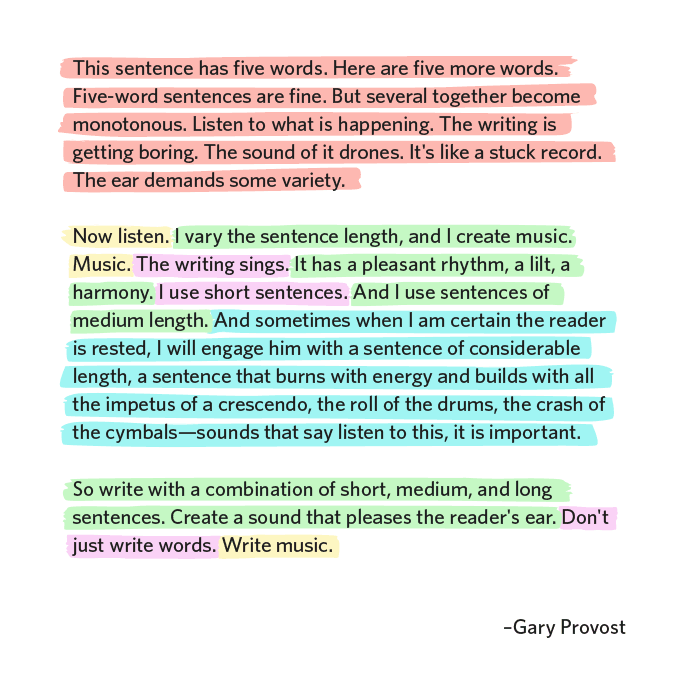
Guys this completely changed my writing, heed it. I often do an entire draft just looking at sentence variation and oftentimes the results are absolutely transformative in the difference.
Let’s take it futher
your pacing can alter the narrative and you can absolutely manipulate the reader doing that
for example
if you have a series of sentences which are long and sprawling you can lure the reader into a comfy state of unawareness. If you finish that with a short sentence, or, even better a one word sentence, it feels like a slap.
If you have sentences that are the same length the inevitable variation jars and you can do that. For example, if you had a robot breaking its programming you can do that subtly with sentence length.
Sentences steadily getting shorter make the action seem faster. Sentences steadily getting longer slow the action down.
short sentences are good for action
long sentences are good for description
fragments [incomplete sentences] work to show a disconnect in the narrative, you can use them in prose not just dialogue
this skill [which is entirely learned] is called Juxtaposition [or the art of putting things next to each other]
I’ve seen more of those “stop telling when you should be showing” articles floating around in my Tumblr feed, and they got me thinking.
I had responded to an article regarding the whole ‘Show Don’t Tell’ mantra before this year rolled around, and my opinion of it still stands. I think that there’s a place for showing and a place for telling in writing. I also think that professing the whole “only do one and not the other” thing is probably sending the wrong message to young writers.
I understand why the advice is given so readily. I know that a lot of novice writers tend to tell way more than they should, and it’s an easy trap to fall into. Showing is much more difficult and much more time-consuming to do. While I agree that it’s important, and that it can vastly improve your writing, I believe that it’s not something you should strive to do all the time. There are instances where telling is more effective than showing. Aside from pacing, which I explained in the first article, here are a couple of other instances I came up with.
When You Have Something to Hide
Showing is unpacking. Showing is using vivid description (including simile and metaphor), sensory details, and actions to allow the reader to experience the story instead of being told via author exposition. When you do this, you make your writing more interesting, but you also draw attention to whatever it is you’re describing.
This stands out: “Wrapped around his body and held together by hundreds of messy cross-stitches, was a trench coat that smelled like moth balls soaked in cheap beer. The stench was so strong that I found myself plunging my nose into the collar of my own coat before I even reached him.”
A line like this does not: “He wore a tattered trench coat.”
As a reader, you remember the lines of good description where the author takes the time to unpack rather than the lines where you’re just told something.
However, telling can be effective when you’re not trying to draw attention to an aspect of your story. For example, say you have a minor character in the beginning of your story that will end up being a major player later on, but you don’t want the readers to know. You’re going to have to briefly introduce that character in some manner, and then have him slip into the background for a while. You can accomplish this by not giving him a lot of focus, and by proxy, not giving him a shown, memorable description.
This applies to not only characters, but to scenes as well. Sometimes there are incredibly boring things that happen in a story that you as an author is going to want to summarize by telling instead of showing.
As author James Scott Bell puts it, “Sometimes a writer tells as a shortcut, to move quickly to the meaty part of the story or scene. Showing is essentially about making scenes vivid. If you try to do it constantly, the parts that are supposed to stand out won’t, and your readers will get exhausted.”
In essence, showing is about choosing what stands out in a story and what doesn’t. Remember when you’re deciding what you should focus on, always ask yourself why. Why is it important that this character, object, or scene stands out?
Tone of Voice
I’m going to say it here, even if some people don’t agree. I think it’s okay to tell tone, and for that matter, pitch of a character’s voice when appropriate.
When we speak, we have “ups and downs”, and even if we don’t understand the language, we can generally tell if someone is asking a question vs. making a joke vs. giving a command vs. being serious based on them. These “ups and downs”, called inflection, are expressed in text through punctuation and by inferring via the subject matter of a conversation.
However, even with these tools, it’s sometimes hard to gauge how a character sounds without being told, especially if the author has something specific in mind or if what a character is saying doesn’t correlate to how they sound.
For example if you have a character who is talking about killing someone, but is overly cheery about it, it may be prudent to mention the tone since it’s not one commonly associated with the topic of murder.
You can also include a word about tone and/or pitch if there’s a specific way the character sounds, like:
Smooth/Rich/Velvety
Nasally/Breathy
Deep/Gruff/Gravelly/Guttural
Keep in mind that you also have great opportunities to show some of these sounds (depending on what you pick) with great descriptions, again keeping in mind how much focus you want to be put on this character’s voice.
Example: “When he spoke it was like he had swallowed a pail of beach sand.”
Final Words
From author Francine Prose, “Needless to say, many great novelists combine “dramatic” showing with long sections of the flat-out authorial narration that is, I guess, what is meant by telling. And the warning against telling leads to a confusion that causes novice writers to think that everything should be acted out … when in fact the responsibility of showing should be assumed by the energetic and specific use of language.”
Showing vs. telling is all about the choice of what’s going to work better for your story. Don’t be afraid to show. Don’t be afraid to tell. Just know there’s a place for each.
One of my favorite studies of Harry Potter is that of the ring composition found both in the individual novels and overall composition. To me, that very composition is what makes Harry Potter such a satisfying story. In my view, it’s a large part of the reason Harry Potter is destined to become a classic.
And it’s an integral part of the series many people are completely unaware of.
So what is ring composition?
It’s a well-worn, beautiful, and (frankly) very satisfying way of structuring a story. John Granger, known online as The Hogwarts Professor, has written extensively on it.
Ring Composition is also known as “chiastic structure.” Basically, it’s when writing is structured symmetrically, mirroring itself: ABBA or ABCBA.
Poems can be structured this way. Sentences can be structured this way. (Ask not what your country can do for you — ask what you can do for your country.) Stories of any length and of any form can be structured this way.
In a novel, the basic structure depends on three key scenes: the catalyst, the crux, and the closing.
The catalyst sets the story into the motion.
The crux is the moment when everything changes. (It is not the climax).
The closing, is both the result of the crux and a return to the catalyst.
In Harry Potter, you might recognise this structure:
Voldemort casts a killing curse on Harry and doesn’t die.
Voldemort attempts to come back to power
Voldemort comes back to power.
Harry learns what it will take to remove Voldemort from power.
Voldemort casts a killing curse on Harry and dies.
But all stories should have this structure. A book’s ending should always reference its beginning. It should always be the result of some major turning point along the way. Otherwise, it simply wouldn’t be a very good story.
What’s most satisfying about chiastic structure is not the basic ABA structure, but the mirroring that happens in between these three major story points.
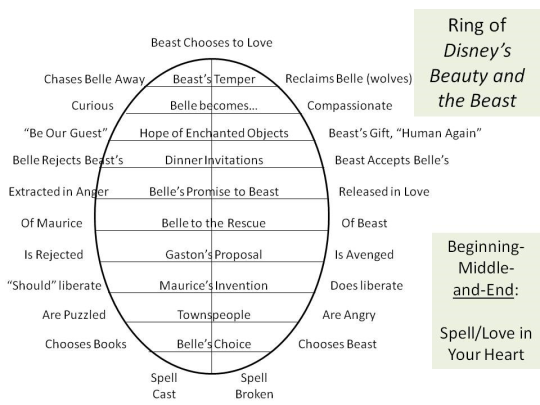
To illustrate what a more complicated ABCDEFGFEDCBA structure looks like, (but not as complicated as Harry Potter’s, which you can see here and here) Susan Raab has put together a fantastic visual of ring composition in Beauty and the Beast (1991), a movie which most agree is almost perfectly structured.
What’s so wonderful about ring composition in this story is that it so clearly illustrates how that one crucial decision of Beast changes everything in the world of the story. Everything from the first half of the story comes back in the second half, effected by Beast’s decision. This gives every plot point more weight because it ties them all to the larger story arc. What’s more, because it’s so self-referential, everything feels tidy and complete. Because everything has some level of importance, the world feels more fully realized and fleshed out. No small detail is left unexplored.
How great would Beauty and the Beast be if Gaston hadn’t proposed to Belle in the opening, but was introduced later on as a hunter who simply wanted to kill a big monster? Or if, after the magnificent opening song, the townspeople had nothing to do with the rest of the movie? Or if Maurice’s invention had never been mentioned again after he left the castle?
Humans are nostalgic beings. We love returning to old things. We don’t want the things we love to be forgotten.
This is true of readers, too.
We love seeing story elements return to us. We love to know that no matter how the story is progressing, those events that occurred as we were falling in love with it are still as important to the story itself as they are to us. There is something inside us all that delights in seeing Harry leave Privet Dr. the same way he got there–in the sidecar of Hagrid’s motorbike. There’s a power to it that would make any other exit from Privet Dr. lesser.
On a less poetic note, readers don’t like to feel as though they’ve wasted their time reading about something, investing in something, that doesn’t feel very important to the story. If Gaston proposed to Belle in Act 1 and did nothing in Act 3, readers might ask “Why was he even in the movie then? Why couldn’t we have spent more time talking about x instead?” Many people do ask similar questions of plot points and characters that are important in one half of a movie or book, but don’t feature in the rest of it.
Now, ring composition is odiously difficult to write, but even if you can’t make your story a perfect mirror of itself, don’t let story elements leave quietly. Let things echo where you can–small moments, big moments, decisions, characters, places, jokes.
It’s the simplest way of building a story structure that will satisfy its readers.
If there’s no place for something to echo, if an element drops out of the story half-way through, or appears in the last act, and you simply can’t see any other way around it, you may want to ask yourself if it’s truly important enough to earn its place in your story.
Further reading:
If you’d like to learn more about ring theory, I’d recommend listening to the Mugglenet Academia episode on it: x
You can also read more about symmetry in HP here: x
And more about ring structure in Lolita and Star Wars here: x and x
And about why story endings and beginnings should be linked here: x
I fuckin LOVE dialogue as a first line. I adore it. whenever I flip open a book and the first line is dialogue I’m like hell YES this is my SHIT
there’s lists of, uh, TOP TEN WAYS YOU SHOULD NEVER START YOUR NOVEL EVER and “opening with dialogue” is always on them
the gist being that it’s bad bc the reader doesn’t care about this character yet so why are they gonna care about this dialogue, right, they don’t have any context for it, you should start with something that gets the reader invested and emotionally pulled in, so on, so forth
(and I’m not here to argue or call bullshit on these lists or anything…… 99% of the time, the reasons listed of why you should Maybe Not Do The Thing are perfectly valid concerns and dangers that should be taken into consideration)
(this post is more a ramble about personal preference with a nice moral at the end)
(and definitely not a TOP TEN REASONS “TOP TEN WAYS YOU SHOULD NEVER START YOUR NOVEL EVER” LISTS ARE LIES AND SLANDER post god could you imagine)
but yeah, for me, dialogue opening lines pull me right the fuck in emotionally. for real. nine times out of ten they’ll yank me in and have me engaged instantaneously. always have, probably always will
(like come on. have y’all never just started eavesdropping right in the middle of some total strangers’ conversation on the bus. especially if it’s somethin weird. it’s so good)
but ANYWAY, the moral is uhhhh
whatever Mortal Writing Sin you wanna commit, there’s probably at least one weirdo out there possibly named logan who digs it
do whatever the fuck you want, honestly
you can write an opening scene that does everything every advice page tells you to do with an opening scene and it can still be shit
you can write an opening scene doing everything every advice page tells you NEVER to do with your opening scene and it can still be fabulous and engaging
if you can pull it off, literally who cares
“if you can pull it off, literally who cares“ is the only real writing rule
Whenever I see lists and articles talking about why you shouldn’t do that one writing thing and how the audience definitely won’t like it if you do that one writing thing, I’m reminded of that one post that encourages writers not to stress about what the audience will like because, chill, the audience will often find you, not the other way around
“This is your daily, friendly reminder to use commas instead of periods during the dialogue of your story,” she said with a smile.
“Unless you are following the dialogue with an action and not a dialogue tag.” He took a deep breath and sat back down after making the clarifying statement.
“However,” she added, shifting in her seat, “it’s appropriate to use a comma if there’s action in the middle of a sentence.”
“True.” She glanced at the others. “You can also end with a period if you include an action between two separate statements.”
Things I didn’t know
“And–” she waved a pen as though to underline her statement–“if you’re interrupting a sentence with an action, you need to type two hyphens to make an en-dash.”
You guys have no idea how many students in my advanced fiction workshop didn’t know any of this when writing their stories.


 the1timetraveller