Draco Malfoy was standing with his back to the door, his hands clutching either side of the sink, his white-blond head bowed.
“Don’t,” crooned Moaning Myrtle’s voice from one of the cubicles. “Don’t… tell me what’s wrong … I can help you…”
“No one can help me,” said Malfoy. His whole body was shaking. “I can’t do it… I can’t… It won’t work… and unless I do it soon … he says he’ll kill me…”
And Harry realized, with a shock so huge it seemed to root him to the spot, that Malfoy was crying–actually crying–tears streaming down his pale face into the grimy basin.
One of my favorite studies of Harry Potter is that of the ring composition found both in the individual novels and overall composition. To me, that very composition is what makes Harry Potter such a satisfying story. In my view, it’s a large part of the reason Harry Potter is destined to become a classic.
And it’s an integral part of the series many people are completely unaware of.
So what is ring composition?
It’s a well-worn, beautiful, and (frankly) very satisfying way of structuring a story. John Granger, known online as The Hogwarts Professor, has written extensively on it.
Ring Composition is also known as “chiastic structure.” Basically, it’s when writing is structured symmetrically, mirroring itself: ABBA or ABCBA.
Poems can be structured this way. Sentences can be structured this way. (Ask not what your country can do for you — ask what you can do for your country.) Stories of any length and of any form can be structured this way.
In a novel, the basic structure depends on three key scenes: the catalyst, the crux, and the closing.
The catalyst sets the story into the motion.
The crux is the moment when everything changes. (It is not the climax).
The closing, is both the result of the crux and a return to the catalyst.
In Harry Potter, you might recognise this structure:
Voldemort casts a killing curse on Harry and doesn’t die.
Voldemort attempts to come back to power
Voldemort comes back to power.
Harry learns what it will take to remove Voldemort from power.
Voldemort casts a killing curse on Harry and dies.
But all stories should have this structure. A book’s ending should always reference its beginning. It should always be the result of some major turning point along the way. Otherwise, it simply wouldn’t be a very good story.
What’s most satisfying about chiastic structure is not the basic ABA structure, but the mirroring that happens in between these three major story points.
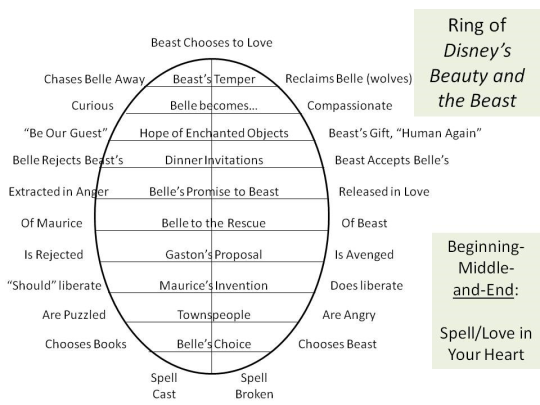
To illustrate what a more complicated ABCDEFGFEDCBA structure looks like, (but not as complicated as Harry Potter’s, which you can see here and here) Susan Raab has put together a fantastic visual of ring composition in Beauty and the Beast (1991), a movie which most agree is almost perfectly structured.
What’s so wonderful about ring composition in this story is that it so clearly illustrates how that one crucial decision of Beast changes everything in the world of the story. Everything from the first half of the story comes back in the second half, effected by Beast’s decision. This gives every plot point more weight because it ties them all to the larger story arc. What’s more, because it’s so self-referential, everything feels tidy and complete. Because everything has some level of importance, the world feels more fully realized and fleshed out. No small detail is left unexplored.
How great would Beauty and the Beast be if Gaston hadn’t proposed to Belle in the opening, but was introduced later on as a hunter who simply wanted to kill a big monster? Or if, after the magnificent opening song, the townspeople had nothing to do with the rest of the movie? Or if Maurice’s invention had never been mentioned again after he left the castle?
Humans are nostalgic beings. We love returning to old things. We don’t want the things we love to be forgotten.
This is true of readers, too.
We love seeing story elements return to us. We love to know that no matter how the story is progressing, those events that occurred as we were falling in love with it are still as important to the story itself as they are to us. There is something inside us all that delights in seeing Harry leave Privet Dr. the same way he got there–in the sidecar of Hagrid’s motorbike. There’s a power to it that would make any other exit from Privet Dr. lesser.
On a less poetic note, readers don’t like to feel as though they’ve wasted their time reading about something, investing in something, that doesn’t feel very important to the story. If Gaston proposed to Belle in Act 1 and did nothing in Act 3, readers might ask “Why was he even in the movie then? Why couldn’t we have spent more time talking about x instead?” Many people do ask similar questions of plot points and characters that are important in one half of a movie or book, but don’t feature in the rest of it.
Now, ring composition is odiously difficult to write, but even if you can’t make your story a perfect mirror of itself, don’t let story elements leave quietly. Let things echo where you can–small moments, big moments, decisions, characters, places, jokes.
It’s the simplest way of building a story structure that will satisfy its readers.
If there’s no place for something to echo, if an element drops out of the story half-way through, or appears in the last act, and you simply can’t see any other way around it, you may want to ask yourself if it’s truly important enough to earn its place in your story.
Further reading:
If you’d like to learn more about ring theory, I’d recommend listening to the Mugglenet Academia episode on it: x
You can also read more about symmetry in HP here: x
And more about ring structure in Lolita and Star Wars here: x and x
And about why story endings and beginnings should be linked here: x
fantastic beasts not only has shit CGI, johnny depp, now they’re trying to sell me on nagini the giant snake becoming a sexy human woman and seducing credence (ezra miller with a bowl cut) like trying to convince me credence and nagini fucked and made snape or some shit this is all too much for me i just want to see newt scamander run around like he’s on doctor who LMFAO
study like a gryffindor: break out the good snacks and pump the music, use breaks as a time to work out, go to the professor’s office hours when you have questions, be confident in your ability to succeed
study like a hufflepuff: organize study groups, do your readings in your comfiest sweaters, write your own notes and study guides from the textbook, be unafraid of the hard work that studying takes
study like a ravenclaw: think critically when re-reading notes, quiz yourself while brushing your teeth, tackle the hardest practice problems, know that you have the skills to get it done
study like a slytherin: use every resource available to study, use your notes to make your own lecture, challenge yourself by setting goals even if you’re not sure you can achieve them, be proud when you do well
It’s the year 2030. They’re making a Harry Potter remake, not a modern adaptation but set in the original era. And it’s fucking indulgent in 90s nostalgia. Someone’s got a butterfly clip, Ron is wearing a choker, there’s muggles playing with pogs, Spice Girls is playing in the background. Voldemort is wearing a crop top.
It’s simultaneously the worst and fucking best thing you’ve ever seen.
I wish I knew the exact time and date that harry told snape ‘there’s no need to call me sir professor’ so that I could take a moment of silence to remember the moment each year
Judging from the context of the chapter…
We know that it’s September 2nd. I’d put it between 9:00 AM and 11:00 AM. (They have breakfast and then a free period. They have Snape’s class before their break, which was before their lunch.)
But in the UK first period typically only starts at 9 AM. So free period from around 9-10 AM and Snapes class from 10-11 AM I’d say.
Okay so 10am-11am every September 2nd is now an hour dedicated to remembering the most glorious piece of dialogue ever spoken by a fictional character
ok this just appeared on my blog with ample time for you all to prepare because apparently I stumbled across it months ago, and scheduled it to post on september first. executive function TRIUMPH!!!!!!!
Worth noting that tomorrow is the 20th anniversary of the greatest burn in history
Hey remember that one character in Harry Potter who came from an abusive family, who told him lies about his life and the world because they wanted to brainwash him so he would be put on the “right path”? And then was shoved into his “destiny” much too young and made to fight for a cause he knew very little about, and even forced to kill someone who had wronged his family even though he was still just a boy? Remember the trials he had to go through, and even though his friends were sometimes with him, he was pretty much alone? Remember how everyone hated him for a while and he felt like he was all alone in the world? Remember how he learned his father was not all that he seemed to be, but decided to love him anyway? Remember the teacher he looked to for guidance treating him like he didn’t need to know anything? Remember his mother who was willing to sacrifice everything, even die, just to protect him? Remember in the 7th book, the choice he made, blindly and willingly, because he wanted to protect his friends and family?

 the1timetraveller