




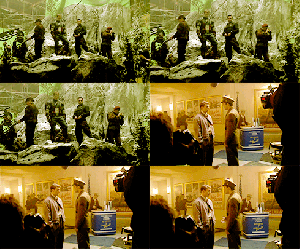

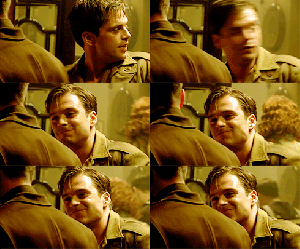


Sebastian Stan behind the scenes of Captain America: The First Avenger
things people do in real world dialogue:
• laugh at their own jokes
• don’t finish/say complete sentences
• interrupt a line of thought with a sudden new one
• say ‘uh’ between words when unsure
• accidentally blend multiple words together, and may start the sentence over again
• repeat filler words such as ‘like’ ‘literally’ ‘really’ ‘anyways’ and ‘i think’
• begin and/or end sentences with phrases such as ‘eh’ and ‘you know’, and may make those phrases into question form to get another’s input
• repeat words/phrases when in an excited state
• words fizzle out upon realizing no one is listening
• repeat themselves when others don’t understand what they’re saying, as well as to get their point across
• reply nonverbally such as hand gestures, facial expressions, random noises, movement, and even silence
Excellent sticky note for dialogue writing in fiction.
All of this. I get a lot of compliments on my dialogue and this list pretty much covers what I do (but some of it, I didn’t even realize I did, lol). I highly recommend reading your dialogue aloud (or imagining it in realtime like a movie scene) to see if it feels natural, which is what I do when editing.
“Everyone thinks Cap’s the perfect fighting machine on account of that super-soldier serum he got. But that ain’t so. The reason Cap’s unstoppable is that he knows who and what he’s fighting for. And he ain’t ever gonna back down from that. Not one inch.”
— Dum Dum Dugan // Captain America Vol. 3 #40 (via steverogersh)
remember when rumlow only made an appearance in cacw to remind the audience that steve is in love with bucky
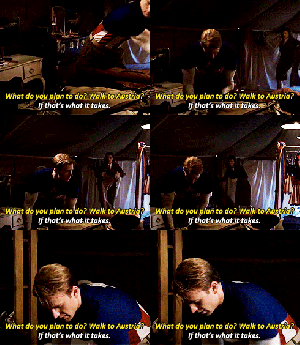
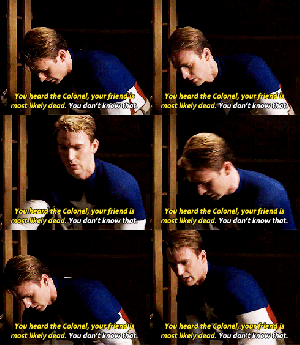
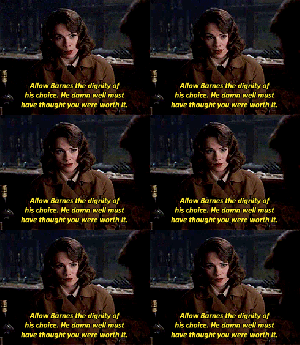
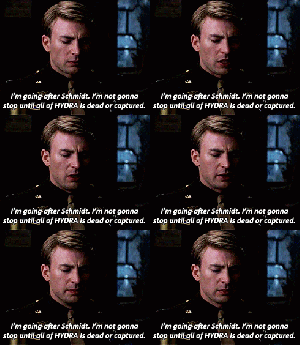
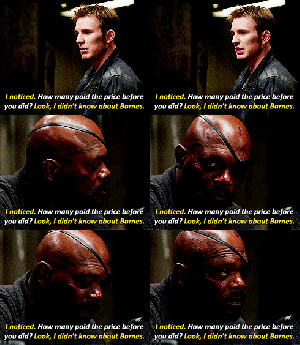
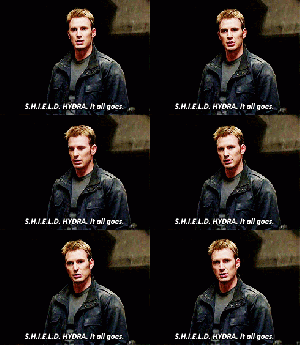
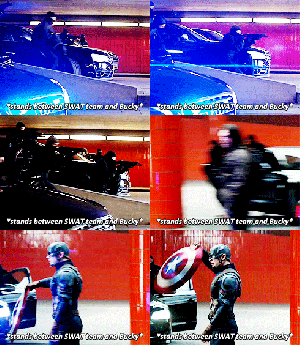
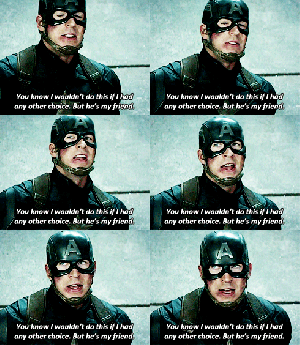
Bucky is Steve’s blind spot. (x)
Literally every Cap movie has been about Steve against all odds, consequences be damned, doing whatever it takes for Bucky Barnes


“If I had written an essay in 2006 about “the future of fandom,” I might have imagined a possible future that looked very much like AO3—except I would have considered it far out of reach. The idea that a community of people could come together to create among themselves both the infrastructure and the code for an entirely new platform is remarkable—but it is even more remarkable that this was a community of mostly women, who are traditionally underrepresented in computer science and even more so in open-source development. Another success of AO3 is that they didn’t just build a platform; they also built a batch of fan-coders because, as the founders realized at the time: “we’re going to have to grow our own”.”
— Fiesler, Casey. 2018. “Owning the Servers: A Design Fiction Exploring the Transformation of Fandom into ‘Our Own.’” In “The Future of Fandom,” special 10th anniversary issue, Transformative Works and Cultures, no. 28. (via fanhackers)
Help me prove a point
ummmmm…only hundreds of times over




 the1timetraveller