THOU is the subject (Thou art…) THEE is the object (I look at thee) THY is for words beginning in a consonant (Thy dog) THINE is for words beginning in a vowel (Thine eyes)
this has been a psa
Also, because H was sometimes treated as a vowel when the grammar rules for thou/thee/thy/thine were formed,THINE can also be used for words beginning with H. For example, both “thy heart” and “thine heart” appear in Elizabethan poetry.
For consistency, however, if you’re saying “thine eyes”, make sure you also say “mine eyes” instead of “my eyes”.
Further to the PSA:
Thou/thee/thine is SINGULAR ONLY.
Verbs with “thou” end in -st or -est: thou canst, thou hast, thou dost, thou goest. Exception: the verbs will, shall, are, and were, which add only -t: thou wilt, thou shalt, thou art, thou wert.
Only in the indicative, though – when saying how things are (“Thou hast a big nose”). Not in the subjunctive, saying how things might be (“If thou go there…”) nor in the imperative, making instructions or requests (“Go thou there”).
The -eth or -th ending on verbs is EXACTLY EQUIVALENT TO THE -(e)s ENDING IN MODERN ENGLISH.
I go, thou goest, she goeth, we go, ye go, they go.
If you wouldn’t say “goes” in modern English, don’t say “goeth” in Shakespearean English.
“Goeth and getteth me a coffee” NO. KILL IT WITH FIRE.
Usually with an imperative you put the pronoun immediately after the verb, at least once in the sentence (“Go thou” / “Go ye”).
YE is the subject (Ye are…). YOU is the object.
Ye/you/your is both for PLURALS and for DEFERENCE, as vous in French.
There’s more, but that’ll do for now.
Oh wow. Reblogging for reference.
i haven’t had my coffee yet, so all i can think of when i read through this is:
th’ain’t
th’dstn’t’ve
AND ANOTHER THING “thee/thou/thy” is informal “ye/you/your” is formal Also also…all of this is NOT Old English but is actually referred to as Early Modern English. If you were speaking Old English, it would sound closer to German.
^That.
And IT’S NOT MORE FORMAL to use THEE.
if you address someone you should use Thee or Ye (sometime used as the plural, sometimes it’s still Thee, rules are iffy) to as You, it’s an insult by intentional distance. If you call someone you should call You by Thee, it can be an insult via assumed intimacy.
(This is why some religions insist on still using Thee and Thou when talking to their Father God. Many of them modernly think it makes them sound more formal, but that’s not why the usage began, or why the more linguistically aware still do it. Not because it’s more formal, but because it’s LESS formal. You wouldn’t call your own Father “You” unless you wanted to imply disowning Him.)
Anyone you’re close to or on first name terms with can be Thee. Friends, family members, etc.
Anyone you want to point out is NOT your friend, respectfully or otherwise, is You. Which is why the King is still Your Majesty. You are decidedly not his friend unless you know each other really well. (See “Henry V”. If you can also call Henry by Harry or Hal, you can probably call him Thee.
One more note! “Ye Olde- as you see on shop signs is not prounounced Yee. There’s a character called a Thorn that was going out of style and being replaced by a curly thing that looks like a Y and IS NOT. It’s pronounced Th. THe olde apothecary shoppe. Not Ye Olde. That itself promptly went out of style as well but the error remains almost traditional.
and I am not addressing claims that I might be a vampire, lycanthrope, or other immortal just because I am fluent in Modern Middle English.
This whole post is a blessing because I read so much “ye olde” speak in historical stuff and everyone always gets their thee’s and thou’s wrong. Even big name authors with accuracy editors who ought to know better.
It’s more accurate to have your “poor folk” in your historical novel saying “thou” than it is to have the scholar or rich man with an education rooted in Latin, unless he’s down the pub with his mates, merry as a knave.
The whole thing just reminds me of people using Polonius’ speech in Hamlet (“to thine own self be true”), completely out of context, not realizing that the speech is intended to show Polonius as a foolish old hypocrite who enjoys dishing out council but rarely follows his own convoluted advice, which is often contradictory and falsely pious.
Which, I mean, Shakespeare often isn’t taught well outside of higher education, lets be honest. So why would they know unless they’ve studied it beyond the passing glance it gets that one year in high school before been relegated to the position of “too posh and old to be relevant” which is entirely not true.
Shakespeare is written in the language of the people, and is often more insightful and progressive than certain types of academics would like you to believe.
In times of crisis, the wise build bridges, while the foolish build barriers. We must find a way to look after one another as if we were one single tribe.
Atomic Blonde – Set in November 1989 on the eve of the collapse of the Berlin Wall, this spy thriller follows M16 agent Lorraine Broughton as she attempts to recover an important stolen item. Along the way she encounters Delphine Lasalle, a rookie french agent. The usage of two different contrasting themes of lighting in this movie is very striking.
Carol – Based off the 1952 lesbian romance novel “The Price of Salt,” Carol is set in New York City in the early 50s. It follows the love affair between Therese Belivet (an aspiring photographer and department store worker) and Carol Aird (a wealthy mother going through a divorce.) It’s a stunning portrayal of gay friendships and romance during a violently homophobic time.
Desert Hearts – Released in 1985 and set in 1959, this romantic drama is often hailed as the first film to present a positive portrayal of lesbianism. It follows Vivian Bell, a english professor in her mid thirties hoping to obtain a quick divorce and Cay Rivvers, a younger and free spirited sculptor.
Farewell, My Queen – French romantic drama set in 1789 during the last three days of Marie Antoinette, seen through the eyes of a young servant who reads to the queen. It discusses rumours of the queens alleged orgies with women and has a very subtle, entirely queer tone.
Heavenly Creatures – Psychological drama documenting the real life Parker-Hulme murder case. The plot centers around the obsessive and concerning relationship between two teenage girls, Juliet and Pauline. It covers their meeting in 1952 all the way through to the murder they commit together in 1954. The girls bond over a shared history of disease, and begin to indulge in delusions of a rich fantasy world and cult-like religion. Its a frightening look into the lives of the two seemingly normal teenager girls who teamed up to kill Pauline’s mother and only served five years for their crime.
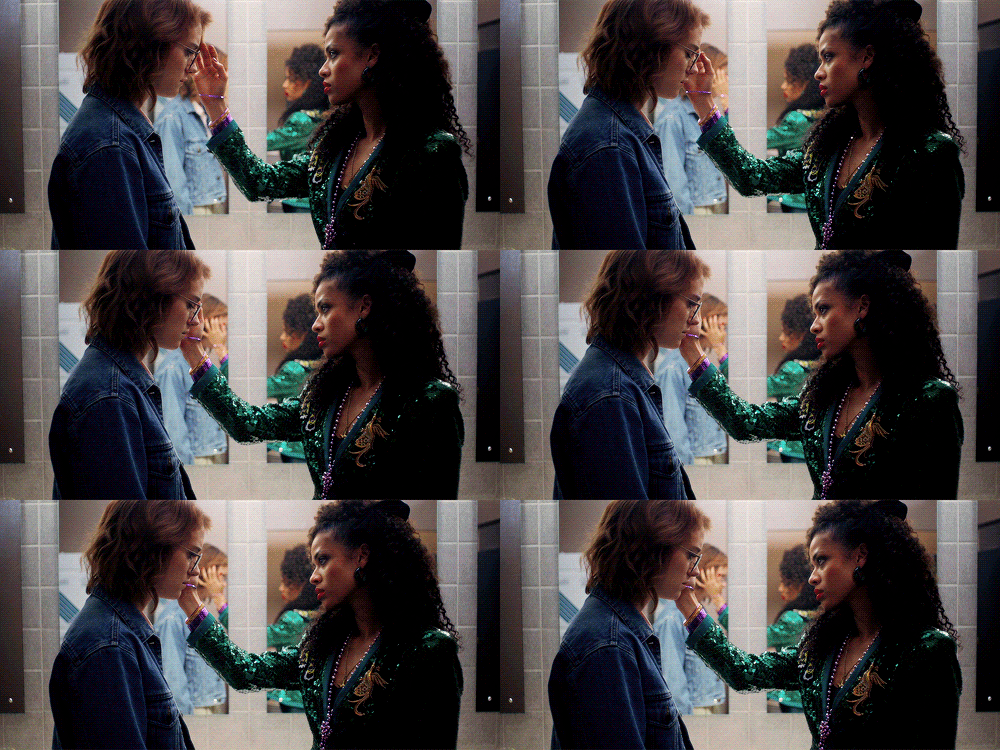
San Junipero – Not technically a film, and not technically set in the past but I think it still counts! This episode of black mirror is praised for having a more hopeful & uplifting tone than the rest of the series and is first set during the 80s, following a lesbian named Yorkie and Kelly, a bisexual woman.
The Girl King – Biographical drama portrayal of the life of Christina, Queen of Sweden. Christina is a brilliant, powerful, and striking figure fighting conservative forces in her country. The film tracks her mission to modernize sweden and follows her awakening sexuality, yet another thing that sets her apart from former rulers.
The Handmaiden – South Korean erotic psychological lesbian revenge thriller. I can honestly say this is one of the most well directed and captivating lesbian films ive ever seen. Sook-Hee, a orphaned Korean pickpocket becomes the handmaiden to a wealthy Japanese Heiress and with the intention to assist a conman in relieving her of her inheritance. It’s loosely inspired by Sarah Waters novel “Fingersmith” but set in Korea under Japanese rule. The male gaze towards lesbians is a reoccuring theme and is accurately portrayed as a disgusting and vile thing in a way i didnt expect a male director to be able to manage.
The Hours – British-American drama based off the novel of the same name. It follows three different queer women of three different eras, all connected through Virgina Woolf’s novel “Mrs. Dalloway.” Clarissa is a bisexual new yorker in the early 2000s, planning an award party for a poet with AIDS. Laura is a pregnant 1950s housewife trapped in an unhappy marriage and Virgina Woolf is a novelist in 1920s england struggling with mental illness under the watchful and suffocating eye of her husband.
The Miseducation of Cameron Post – One of the newest releases, this film just came out this year! Set in 1993 and based off the novel of the same name by Emily M. Danforth, teenager Cameron is caught in the backseat of a car with the prom queen. Her aunt (a devout christian) ships Cameron off to a religious gay conversion camp called God’s Promise. The film documents the struggles, pain, and violence of existing in a space with no place for you.
































 the1timetraveller